

UCC

  • Main
  • Staff
  • Home
  • About UCC
  • Libraries
  • Alumni
  • Staff Directory
  • Financial Support
  • Forms
  • E-Learning
  • International Office
  • Web Services
  • Contacts & maps
  • A to Z list
  • Sitemap
  • EXPLORE UCC
    • Awards & achievements
      • Honorary Degree Award
    • Corporate Strategic Plan
    • Plans & policies
    • Governance and Administration
    • Statutes of UCC
    • Annual Report
    • Our Campus
      • Halls
        • Adehye
        • Atlantic
        • Casley Hayford
        • Kwame Nkrumah
        • Oguaa Hall
        • Valco
    • History
    • Book/Paper Collaborations
    • Recreational & Social Activities
    • Useful Facilities
    • Resources
    • Data Hub
      • Enrollment, Courses and Graduation Statistics (2022/2023)
      • Research and Financial Statistics
      • UCC Summary Statistics
      • Fast Facts
    • SDGs Report 2024
  • ACADEMICS
    • Academic Calendar
    • Programmes
      • All
      • Non-degree
      • Undergraduate
      • Masters
      • Doctorate
    • Colleges
    • Faculties and Schools
    • Departments
    • Affiliate Institutions
    • Africa Centre of Excellence in Coastal Resilience
    • Office of International Relations
    • Dean of Students' Affairs
    • Directorate Academic Planning and Quality Assurance
    • Directorate of Academic Affairs
    • School of Graduate Studies
  • APPLICANTS & STUDENTS
  • RESEARCH & INNOVATION
    • DRIC
    • Research Support Grant (RSG)
    • Conference Portal
    • UCC Scholar
  • LIBRARY
  • DISTANCE EDUCATION
  • NEWS & MEDIA
    • News
    • Events
    • Videos
    • VC's Desk
    • Inaugural Lectures
    • Press Releases

Search

  • Home

UCC Management Holds Retreat with Student Leadership

02 Mar, 2018 By louis Mensah

The management and the student leadership of University of Cape Coast have embarked on a three-day retreat in Takoradi, Western Region from Friday, 23rd -Sunday, 25th February, 2018.

The retreat which is bi-annual enables management of the University and the student leadership to take stock of activities in the University for the past year and also adopt strategies that would help create a conducive academic environment for all members of the University.

Opening the workshop, the Vice-Chancellor, Prof. Joseph Ghartey Ampiah, underscored the importance of the retreat and explained that it was an opportunity to evaluate what has been done in the past and find ways of improving them. He called for cooperation between management and students’ leadership to help provide a serene atmosphere for students to have a lifetime learning experience.

The Chairman of the Monitoring and Evaluation Team of Management/Student leadership retreats who also doubles as the Vice-Dean of Students’ Affairs used the occasion to apprise members of the progress made with the resolutions that were reached at the previous retreat. Members observed that about 80% of the resolutions at the previous retreat has been achieved. The remaining 20% were ongoing projects such as rehabilitation of lecture theatres, improvement of ICT infrastructure and other minor projects.

Issues that came up for discussion bothered on academic, staff and students’ welfare, hall activities, security, works and services and other general issues.

At the retreat, members agreed, among other things, that first year students on the distance education programme should be affiliated to halls of residence. This is to give them a sense of belonging and also provide them with certain privileges.

The Vice-Chancellor reiterated that any student group that initiates disturbances on campus that will call for police reinforcement will be surcharged for the cost associated with the re-enforcement.

The team of University Management comprised the Vice-Chancellor, Prof. Joseph Ghartey Ampiah; the Pro-Vice Chancellor, Prof. G. K. T. Oduro; the Registrar, Mr. J. K. Nyan; the Director of Finance, Mrs. Elizabeth Obese.

The others members of management were Prof. L. K. Sam Amoah, Provost of the College of Agriculture and Natural Sciences; Prof. Eric Magnus Wilmot, Provost, College of Education Studies; Prof. Dora F. Edu-Buandoh, Provost, College of Humanities and Legal Studies, Prof. Isaac Galyuon, Provost, College of Distance Education and Prof. Johnson Nyarko Boampong, Provost, College of Health and Allied Sciences.

Other participants included some directors of directorates, heads of hall of residence, the Dean and Vice-Dean of Students’ Affairs, the Head of Security; JCRC Presidents of the various halls of residence; Presidents of the Student Representative Council, Graduate Students’ Association of Ghana - UCC Chapter and Distance Education Students Association of Ghana - UCC.

In all, a total of 48 resolutions were reached for implementation.
Administration

UCC Management Holds Retreat with Student Leadership

02 Mar, 2018 By louis Mensah

The management and the student leadership of University of Cape Coast have embarked on a three-day retreat in Takoradi, Western Region from Friday, 23rd -Sunday, 25th February, 2018.

The retreat which is bi-annual enables management of the University and the student leadership to take stock of activities in the University for the past year and also adopt strategies that would help create a conducive academic environment for all members of the University.

Opening the workshop, the Vice-Chancellor, Prof. Joseph Ghartey Ampiah, underscored the importance of the retreat and explained that it was an opportunity to evaluate what has been done in the past and find ways of improving them. He called for cooperation between management and students’ leadership to help provide a serene atmosphere for students to have a lifetime learning experience.

The Chairman of the Monitoring and Evaluation Team of Management/Student leadership retreats who also doubles as the Vice-Dean of Students’ Affairs used the occasion to apprise members of the progress made with the resolutions that were reached at the previous retreat. Members observed that about 80% of the resolutions at the previous retreat has been achieved. The remaining 20% were ongoing projects such as rehabilitation of lecture theatres, improvement of ICT infrastructure and other minor projects.

Issues that came up for discussion bothered on academic, staff and students’ welfare, hall activities, security, works and services and other general issues.

At the retreat, members agreed, among other things, that first year students on the distance education programme should be affiliated to halls of residence. This is to give them a sense of belonging and also provide them with certain privileges.

The Vice-Chancellor reiterated that any student group that initiates disturbances on campus that will call for police reinforcement will be surcharged for the cost associated with the re-enforcement.

The team of University Management comprised the Vice-Chancellor, Prof. Joseph Ghartey Ampiah; the Pro-Vice Chancellor, Prof. G. K. T. Oduro; the Registrar, Mr. J. K. Nyan; the Director of Finance, Mrs. Elizabeth Obese.

The others members of management were Prof. L. K. Sam Amoah, Provost of the College of Agriculture and Natural Sciences; Prof. Eric Magnus Wilmot, Provost, College of Education Studies; Prof. Dora F. Edu-Buandoh, Provost, College of Humanities and Legal Studies, Prof. Isaac Galyuon, Provost, College of Distance Education and Prof. Johnson Nyarko Boampong, Provost, College of Health and Allied Sciences.

Other participants included some directors of directorates, heads of hall of residence, the Dean and Vice-Dean of Students’ Affairs, the Head of Security; JCRC Presidents of the various halls of residence; Presidents of the Student Representative Council, Graduate Students’ Association of Ghana - UCC Chapter and Distance Education Students Association of Ghana - UCC.

In all, a total of 48 resolutions were reached for implementation.

Administration
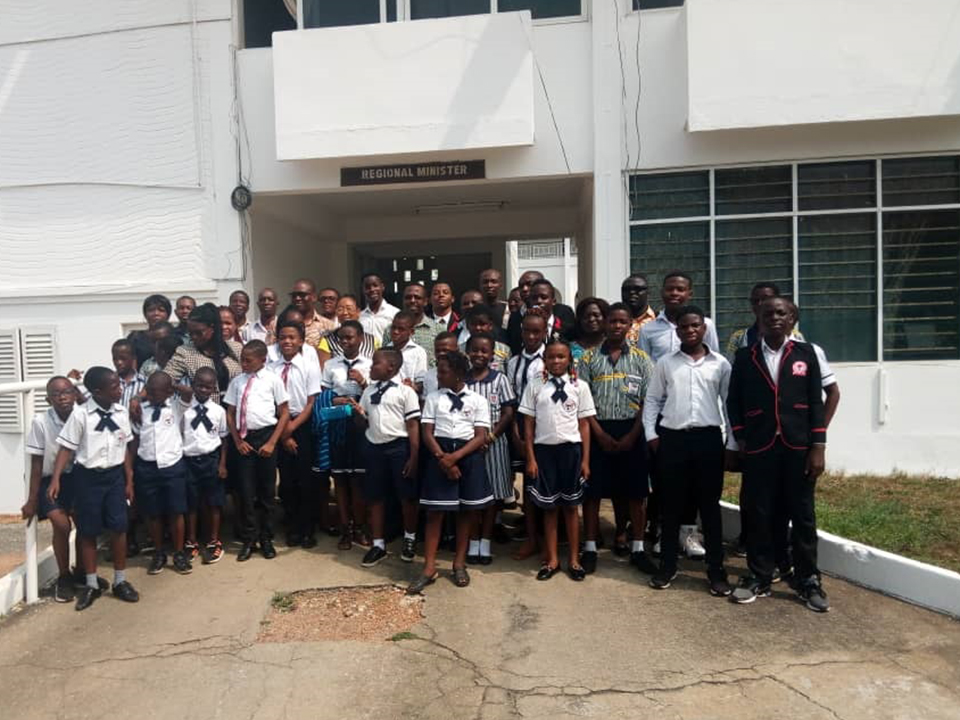
The exchange pupils and headteachers of the University Basic Schools with the Central Regional Minister, Mr. Kwamina Duncan

UCC Management Holds Retreat with Student Leadership

02 Mar, 2018 By louis Mensah

The management and the student leadership of University of Cape Coast have embarked on a three-day retreat in Takoradi, Western Region from Friday, 23rd -Sunday, 25th February, 2018.

The retreat which is bi-annual enables management of the University and the student leadership to take stock of activities in the University for the past year and also adopt strategies that would help create a conducive academic environment for all members of the University.

Opening the workshop, the Vice-Chancellor, Prof. Joseph Ghartey Ampiah, underscored the importance of the retreat and explained that it was an opportunity to evaluate what has been done in the past and find ways of improving them. He called for cooperation between management and students’ leadership to help provide a serene atmosphere for students to have a lifetime learning experience.

The Chairman of the Monitoring and Evaluation Team of Management/Student leadership retreats who also doubles as the Vice-Dean of Students’ Affairs used the occasion to apprise members of the progress made with the resolutions that were reached at the previous retreat. Members observed that about 80% of the resolutions at the previous retreat has been achieved. The remaining 20% were ongoing projects such as rehabilitation of lecture theatres, improvement of ICT infrastructure and other minor projects.

Issues that came up for discussion bothered on academic, staff and students’ welfare, hall activities, security, works and services and other general issues.

At the retreat, members agreed, among other things, that first year students on the distance education programme should be affiliated to halls of residence. This is to give them a sense of belonging and also provide them with certain privileges.

The Vice-Chancellor reiterated that any student group that initiates disturbances on campus that will call for police reinforcement will be surcharged for the cost associated with the re-enforcement.

The team of University Management comprised the Vice-Chancellor, Prof. Joseph Ghartey Ampiah; the Pro-Vice Chancellor, Prof. G. K. T. Oduro; the Registrar, Mr. J. K. Nyan; the Director of Finance, Mrs. Elizabeth Obese.

The others members of management were Prof. L. K. Sam Amoah, Provost of the College of Agriculture and Natural Sciences; Prof. Eric Magnus Wilmot, Provost, College of Education Studies; Prof. Dora F. Edu-Buandoh, Provost, College of Humanities and Legal Studies, Prof. Isaac Galyuon, Provost, College of Distance Education and Prof. Johnson Nyarko Boampong, Provost, College of Health and Allied Sciences.

Other participants included some directors of directorates, heads of hall of residence, the Dean and Vice-Dean of Students’ Affairs, the Head of Security; JCRC Presidents of the various halls of residence; Presidents of the Student Representative Council, Graduate Students’ Association of Ghana - UCC Chapter and Distance Education Students Association of Ghana - UCC.

In all, a total of 48 resolutions were reached for implementation.

News

Holy Child SHS Wins GSA Debate

01 Mar, 2018 By louis Mensah

Holy Child Senior High School (SHS) has emerged champions of the Ghana Science Association (GSA) inter- school debate competition held at the University of Cape Coast.

The School won the contest with 90.2 points as against 83 points for Edinaman SHS, whilst Adisadel College placed third with 82 points.

The competition, which was organised by the Cape Coast Branch of the Association, was on the motion: “Students should be allowed to use mobile phones in SHS”.

The winners, Holy Child SHS, spoke against the motion, whilst the first and second runner-ups Edinaman SHS and Adisadel College respectively were for the motion. For their prizes, the contestants of the Holy Child SHS took home an undisclosed amount of cash, certificates each and a shield of honour for their school.

Adisadel College and Edinaman SHS contestants received certificates each and shields of honour for their schools.

Nana Ekua Yeboah Benedicta and Miss Paulina Selasie Kukuwaa Wilson, who represented Holy Child SHS, as Principal Speaker and First Supporting Speaker, respectively, opined that the use of mobile phones in SHS would cause disruption of academic work, promote immoral behaviour and cyber fraud, increase the rate of examination malpractices and pose danger to the individual in terms of explosion. The contestants further argued that the use of mobile phones amongst SHS students would cause fire outbreaks in schools due to illegal connections; it would also give students easy access to pornographic materials, adding among other things that there would be ineffective control, regulation and censorship of mobile phones.

Contestants from Edinaman SHS, represented by Affram Erica Selassie and Precious Addor, who held a contrary view, contended that mobile phones would enhance conference learning to enable students to involve in group work regardless their locations. " As students, group work will never leave our door step. Every school has day students. How do you expect day students to benefit from after school discussions? With mobile phones, students can sit at their comfort zones and discuss group work with just a conference call or create a WhatsApp group page to serve as a forum for  discussion between students and their teachers," they argued.

The debaters from Edinaman SHS, in their submission, appealed to the Ghana Education Service to lift the ban on mobile phones in High Schools and rather introduce guidelines to regulate the use of mobile phones amongst SHS students. They also supported the call by the Ministry of Communications for stakeholders in education to take a second look  at the ban on mobile phone use among second-cycle students across the country.

Masters Isaac Ayeyi Turkson and Ashley David, from Adisadel College, also debated in favour of the motion.

The President of Cape Coast branch of GSA, Prof. Victor Y.A. Barku, congratulated the three competing schools on their hard work. He said GSA organized the debate to encourage second cycle students to study science as the first choice subject. He urged the public to place premium on Science and Technology for rapid development of the country. He said the competition witnessed nine schools from the metropolis in the preliminary stage, with six schools qualifying to the quarter finals stage and three schools competing for the finals.

Sharing his perspectives on the motion with the media after the debate, Prof. Barku backed calls for the use of mobile phones in Second Cycle schools. He said:" Mobile phone is a technology. To me the question is: Is mobile phone disruptive or constructive? To me as a scientist, I will say it is constructive.It is good for our kids."

The Chief Judge for the debate, Rev. Dr. Philip Gborsong, who led a three- panel of judges from the Department of Communication Studies to award marks, said Science and Technology is the bedrock for the development of nations. He called on students and the public to propagate the study of science in their endeavours.

The function was chaired by the Dean of the School of Physical Sciences, Prof. David K. Essuman.

Administration

Holy Child SHS Wins GSA Debate

01 Mar, 2018 By louis Mensah

Holy Child Senior High School (SHS) has emerged champions of the Ghana Science Association (GSA) inter- school debate competition held at the University of Cape Coast.

The School won the contest with 90.2 points as against 83 points for Edinaman SHS, whilst Adisadel College placed third with 82 points.

The competition, which was organised by the Cape Coast Branch of the Association, was on the motion: “Students should be allowed to use mobile phones in SHS”.

The winners, Holy Child SHS, spoke against the motion, whilst the first and second runner-ups Edinaman SHS and Adisadel College respectively were for the motion. For their prizes, the contestants of the Holy Child SHS took home an undisclosed amount of cash, certificates each and a shield of honour for their school.

Adisadel College and Edinaman SHS contestants received certificates each and shields of honour for their schools.

Nana Ekua Yeboah Benedicta and Miss Paulina Selasie Kukuwaa Wilson, who represented Holy Child SHS, as Principal Speaker and First Supporting Speaker, respectively, opined that the use of mobile phones in SHS would cause disruption of academic work, promote immoral behaviour and cyber fraud, increase the rate of examination malpractices and pose danger to the individual in terms of explosion. The contestants further argued that the use of mobile phones amongst SHS students would cause fire outbreaks in schools due to illegal connections; it would also give students easy access to pornographic materials, adding among other things that there would be ineffective control, regulation and censorship of mobile phones.

Contestants from Edinaman SHS, represented by Affram Erica Selassie and Precious Addor, who held a contrary view, contended that mobile phones would enhance conference learning to enable students to involve in group work regardless their locations. " As students, group work will never leave our door step. Every school has day students. How do you expect day students to benefit from after school discussions? With mobile phones, students can sit at their comfort zones and discuss group work with just a conference call or create a WhatsApp group page to serve as a forum for  discussion between students and their teachers," they argued.

The debaters from Edinaman SHS, in their submission, appealed to the Ghana Education Service to lift the ban on mobile phones in High Schools and rather introduce guidelines to regulate the use of mobile phones amongst SHS students. They also supported the call by the Ministry of Communications for stakeholders in education to take a second look  at the ban on mobile phone use among second-cycle students across the country.

Masters Isaac Ayeyi Turkson and Ashley David, from Adisadel College, also debated in favour of the motion.

The President of Cape Coast branch of GSA, Prof. Victor Y.A. Barku, congratulated the three competing schools on their hard work. He said GSA organized the debate to encourage second cycle students to study science as the first choice subject. He urged the public to place premium on Science and Technology for rapid development of the country. He said the competition witnessed nine schools from the metropolis in the preliminary stage, with six schools qualifying to the quarter finals stage and three schools competing for the finals.

Sharing his perspectives on the motion with the media after the debate, Prof. Barku backed calls for the use of mobile phones in Second Cycle schools. He said:" Mobile phone is a technology. To me the question is: Is mobile phone disruptive or constructive? To me as a scientist, I will say it is constructive.It is good for our kids."

The Chief Judge for the debate, Rev. Dr. Philip Gborsong, who led a three- panel of judges from the Department of Communication Studies to award marks, said Science and Technology is the bedrock for the development of nations. He called on students and the public to propagate the study of science in their endeavours.

The function was chaired by the Dean of the School of Physical Sciences, Prof. David K. Essuman.

Administration

UCC Audit Committee Inaugurated

01 Mar, 2018 By louis Mensah

The Audit Committee of the University of Cape Coast has been inaugurated with a call on members to help rebrand the University.

The new committee replaces the Audit Implementation Committee (ARIC) which was charged with the responsibility of ensuring that the institution carried out the recommendations made by its External Auditors. This follows the promulgation of the Public Financial Management Act, 2016 (Act 921).

Members of the committee are Prof. Kwame Boasiako Omane-Antwi, chairman, Mr. Samuel Petterson, Internal Audit representative, Mr. Kofi Abaidoo, Institute of Chartered Accountants Ghana, Dr. Thomas Agyarko-Poku and Dr. Edem Amenumey both representing the University Council. Members of the Committee would serve for a period of two years.

Inaugurating the committee, Chairperson of the Governing Council of the University, Mrs. Nancy Thompson called on the members to give attention to very delicate and sensitive tasked assigned them. “I have no doubt that you will carry out your assignment with diligence, commitment, objectivity, transparency and teamwork”, she said.

On the need to adhere to strict confidentiality, Mrs. Thompson said: “In executing your responsibility, members and secretarial staff may have access to confidential information. Therefore, it is important to maintain strict confidentiality of proceedings and materials to the fullest extent”. She said, she was confident of the caliber of members of the Audit committee and therefore, believed the University and the entire country would benefit immensely from their rich knowledge, expertise and experience.

The Chairperson of UCC Council later sworn into office members of the committee.

Addressing members of the committee, the Acting Director of the Internal Audit Agency, Mr. Ransford Adjei, called on the committee to ensure strict adherence rules and policies that govern financial management of the University and therefore, urged them to be abreast with the enabling Act of the University and the Public Financial Management Act (921). Mr. Adjei advised members of the committee to ensure that all policies that were not currently in place were fashioned out and made operational.

Mr. Adjei reminded the committee that it had all the powers and authority to invite persons or request for documents that would help it carry out its mandate as efficient and effective as possible. He advised members to collaborate and work harmoniously with the Vice-Chancellor since it was his responsibility now to see to the implementation of any report that the committee churned out.

In his remarks, chairman of the committee, Prof. Omane-Antwi said the committee would bring independent perspectives to bear in its work to add value to the University adding that “this committee was set up to supplement and not supplant the University”.

Prof. Omane-Antwi said the committee would employ effective risk management practices and good control measures so as to achieve the aims for which it set up. He called for support from both the management and the Directorate Internal Audit to save the University from “Bad press”.


Administration

Delegation from Germany Pays Courtesy Call on Pro-Vice-Chancellor

01 Mar, 2018 By louis Mensah

Three officials from Germany have paid courtesy call on the Pro-Vice-Chancellor, Prof. George K. T. Oduro as part of a working visit to the University of Cape Coast.

The officials were Raimund Vogels and Michael Fuhr from the University of Heldsheim, Germany and Dorothee Schwats from German Academic Exchange Service (DAAD), Bonn.

Explaining the purpose of the visit, the Provost of the College of Humanities and Legal Studies, Prof. Dora Edu-Buandoh, who led the officials said UCC, University of Maiduguri, Nigeria and University of Heldsheim, Germany have signed Memorandum of Understanding (MoU) to train postgraduate students at the Ph.D and Masters levels. She noted that as part of the collaboration, UCC was hosting the SDG-Graduate School workshop with sponsorship from DAAD.

Welcoming the officials, Prof. Oduro said the agenda of UCC was to establish visibility internationally and through partnership adding that “this project will help our graduates to gain international recognition”.  He assured the officials of UCC management’s commitment to create an enabling environment for the project to succeed. “You have to begin working towards renewal of the project after it expires because UCC has a good financial regulation system so monies for projects are put into good use.”

Prof. Oduro also commended DAAD for supporting South-South collaboration noting that “it is mostly difficult to find two or more African Universities collaboration but DAAD has shown the way by providing this opportunity”.

On her part, Dorothee Schwats promised to continuously support the South-South cooperation and also promote cultural diversity though academic work.

Present at the meeting were the Registrar, Mr. John Kofi Nyan and Dr. Florian Carl, head, Department of Music and Dance.

Administration
28 Feb, 2018

The Centre for Gender, Research, Advocacy and Documentation (CEGRAD), will be organising a Symposium to commemorate this year's International Women's Day. The schedule for the event is as follows:

Date: Thursday, 8th March, 2018
Time: 10:00 a. m.
Venue: Yamoransa Star Entertainment Centre


27 Feb, 2018

Constructing Research Frameworks on the Sustainable Development Goals in Africa’s Policy Environment

2-14 April 2018 (University of Cape Coast, Ghana)

PDF icon cfa_summer_school_ucc_ghana_april_2018_final_ghanaian_applicants_.pdf

UCC Launches Maiden Research Report

27 Feb, 2018 By louis Mensah

The University of Cape Coast, UCC, has launched its maiden research report for the collective benefit of society.   The 184-page document, issued by the Directorate of Research, Innovation and Consultancy (DRIC), comprises research output from the colleges and other research directorates and centres of the University.   Spanning 2012 to 2016, the report also covers a plethora of research areas in the Arts, Education, Social Sciences, Medical Sciences and the Natural Sciences undertaken by individuals, departments, and faculties, either independently or in collaboration with other institutions, government and non-governmental organizations, donor agencies and development partners.   The Vice-Chancellor, Prof. Joseph Ghartey Ampiah, who launched the report, said the University remained committed to research and was open for collaborative research efforts with other research -oriented individuals, academic institutions of higher learning, industry and development partners for cutting- edge research activities that would advance the frontiers of knowledge for sustainable development.   In the light of this, Prof. Ampiah encouraged faculty to always endeavour to research so as to make themselves and the university visible across the world.   He also charged lecturers to produce at least one high quality research informed article every year.   He commended researchers in the university for their publications over the last five years and entreated other faculty members to research to enable DRIC to capture their research activities in the next report, which will be launched in 2019.   He urged faculty to contribute to the report, to search for collaborators and seek for grants in order to do innovative research.   On behalf of the University Council, the Vice-Chancellor commended the dedicated researchers and research administrators whose research endeavors and administrative support respectively made the publication of the maiden edition of the research report possible.   The Director of DRIC, Prof. Samuel Kobina Annim, noted that the launch of the report was a clear demonstration of the credibility of faculty to engage in good research.   Prof. Annim used the launch to clear up some misconceptions held by a section of faculty members about the role of DRIC in the University. According to him, DRIC indulges in administrative research, whilst the other research centers in the University engage in scientific research.   He, therefore, appealed to faculty to collaborate with the Directorate regarding issues on research, innovation and consultancy, pointing out that DRIC was not established to take over research activities of faculty members.   Contrary to popular opinion, the Director stated that the Directorate has Consultancy Policy, Research Agenda and Research Policy guiding the conduct of research in the University.   He announced that DRIC had developed a trial researcher database, an online platform that would help colleagues to update themselves, as well as grants and publications.   The Deputy Director of DRIC, Prof. Fredrick Ato Armah, gave an overview of the Maiden Research Report, highlighting the total research funds, research domains attracting  more funds, areas that require funding attention and, funding agencies by category.     A former Director of DRIC, Prof. Albert Abane, who chaired the launch, urged management  to motivate researchers in the University to enable them to publish and  also to collaborate with distinguished institutions that engage in innovative research.   He entreated researchers to make their research findings available to industry players and policy makers to enhance socio-economic development of the country.   He called on major stakeholders to support DRIC to achieve its mandate.    

News

Pages

  • « first
  • ‹ previous
  • …
  • 1100
  • 1101
  • 1102
  • 1103
  • 1104
  • 1105
  • 1106
  • 1107
  • 1108
  • …
  • next ›
  • last »

Admissions

Graduate
Sandwich
International
Undergraduate
Distance Education

Colleges

Education Studies
Distance Education
Health and Allied Sciences
Humanities and Legal Studies
Agriculture and Natural Sciences

Research

Support Grant
Policies and Guidelines
Reports
Agenda
Inaugural Lectures
Intellectual Property Policy

Directorates

Finance
ICT Services
Public Affairs
Internal Audit
Academic Affairs
Human Resource
University Health Services
Consular and General Services
Research, Innovation & Consultancy
Academic Planning & Quality Assurance
Physical Development & Estate Management

Policies & Reports

Web Policy
Annual Report
Conditions of Service
Corporate Strategic Plan

Services

Portal
ATL FM
Alumni
UCOSIS
eLearning
Staff Email
Faculty Blogs
Student Email
Staff Directory
Academic Calendar
Affiliate Institutions

Contact info

The Registrar, University of Cape Coast, Cape Coast, Ghana.
  • +233 [03321]32440, +233 [03321] 32480-9
  • registrar@ucc.edu.gh

Website & Media

Forms
Sitemap
Web Services
Press Releases
Contact & Maps
Announcements
Inaugural Lectures
Services Status
  • ‌
  • ‌
  • ‌‌
  • ‌
  • ‌
  • ‌
  • ‌
  • ‌

©2025 University of Cape Coast