
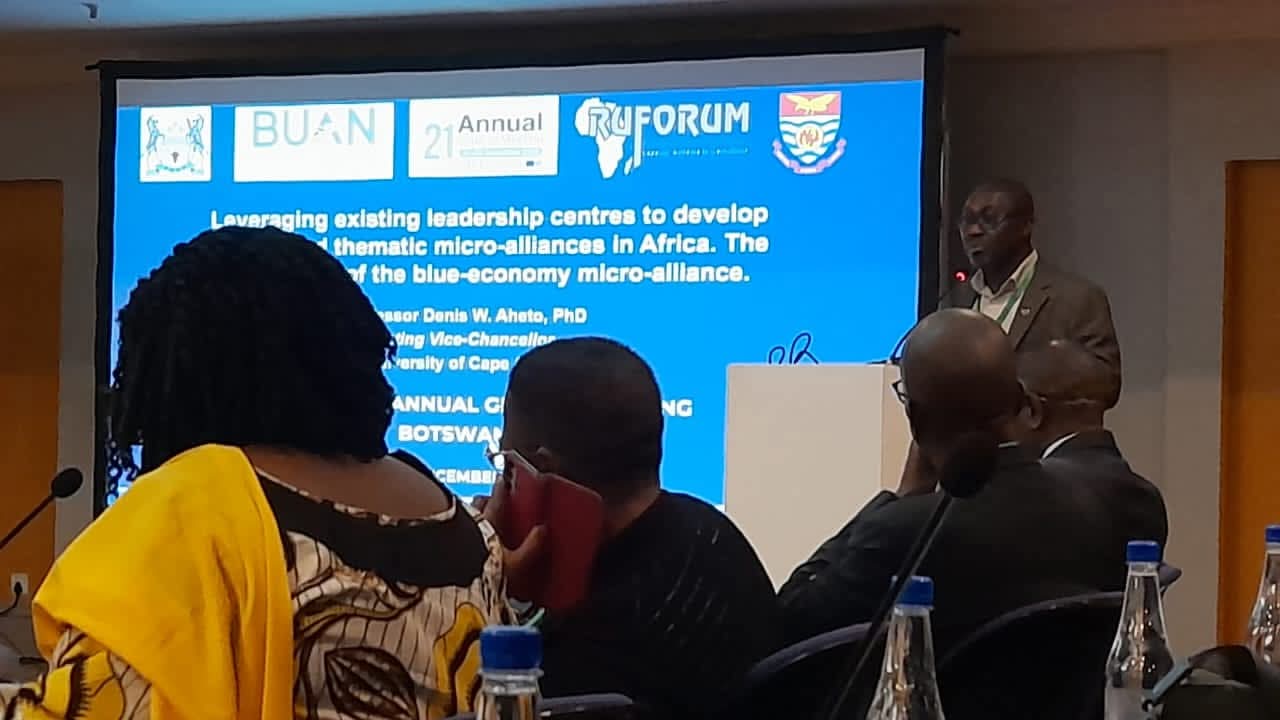
The Acting Vice-Chancellor of the University of Cape Coast (UCC), Professor Denis Worlanyo Aheto, has proposed a framework for creating sustainable and inclusive blue economy micro-alliances for fisheries development towards economic growth in Africa.
Prof. Aheto made this call at the Vice-Chancellor’s Forum at the 21st Regional Universities Forum for Capacity Building in Agriculture (RUFORUM) Annual General Meeting (AGM) in Gaborone, Botswana, where he delivered a lead paper titled “Leveraging Existing Leadership Centres to Develop Specialised Thematic Micro-Alliances in Africa: The Case of the Blue-Economy Micro-Alliance.”
RUFORUM is holding its 21st Annual General Meeting (AGM) between 1st and 5th December in Gaborone, Botswana, under the theme “Positioning Africa’s Universities and the Higher Education Sector to effectively impact development processes on the continent”.
The Ag. Vice-Chancellor noted that Africa possessed significant ocean resources, with 38 coastal states and six island nations, amounting to over 13 million square kilometres of ocean territory. He emphasised that the continent’s coastline, stretching approximately 26,000 nautical miles, underpins an ocean economy valued at USD 300 billion to support 49 million jobs as of 2018 but projected to rise significantly by 2030.
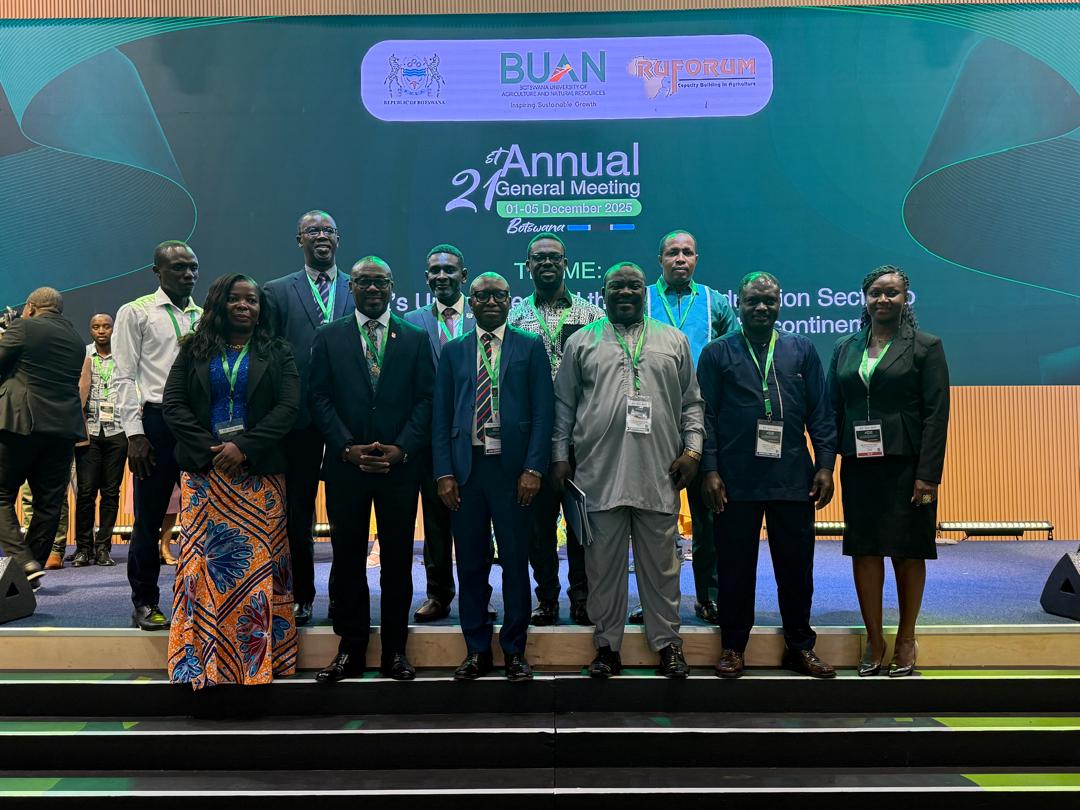
UCC delegation at the event
Prof. Aheto stressed that despite abundant marine resources, Africa had not fully harnessed the potential of sectors such as fisheries, aquaculture, shipping, coastal tourism, marine energy and ocean mining. Strengthening Centres of Excellence (CoEs), he noted, would provide a strategic pathway to achieving sustainable development and economic transformation.
The CoEs are critical for driving innovation, improving research, and building the high-level skills necessary for the continent’s growth, he said, citing successful models supported by the World Bank and the African Union.
In order to address these issues in the blue economy, Professor Aheto proposed a practical framework for establishing Blue Economy micro-alliances, emphasising clear identification of Centres of Excellence and shared strategic goals.
He further called for coordinated resource mobilisation, strong industry linkages, capacity building, and sustained monitoring and evaluation to enhance knowledge sharing, improve access to funding, and strengthen partnerships among universities, governments, and private sector actors.
Prof. Aheto underscored the importance of sustainable marine fisheries, noting that “while industrial fisheries struggle with issues such as overfishing and destructive practices, small-scale fisheries offer a more sustainable path aligned with Blue Economy principles.
He urged African governments, higher education institutions, and development partners to prioritise investment in the Blue Economy and support collaborative structures that will drive economic growth and poverty reduction.